
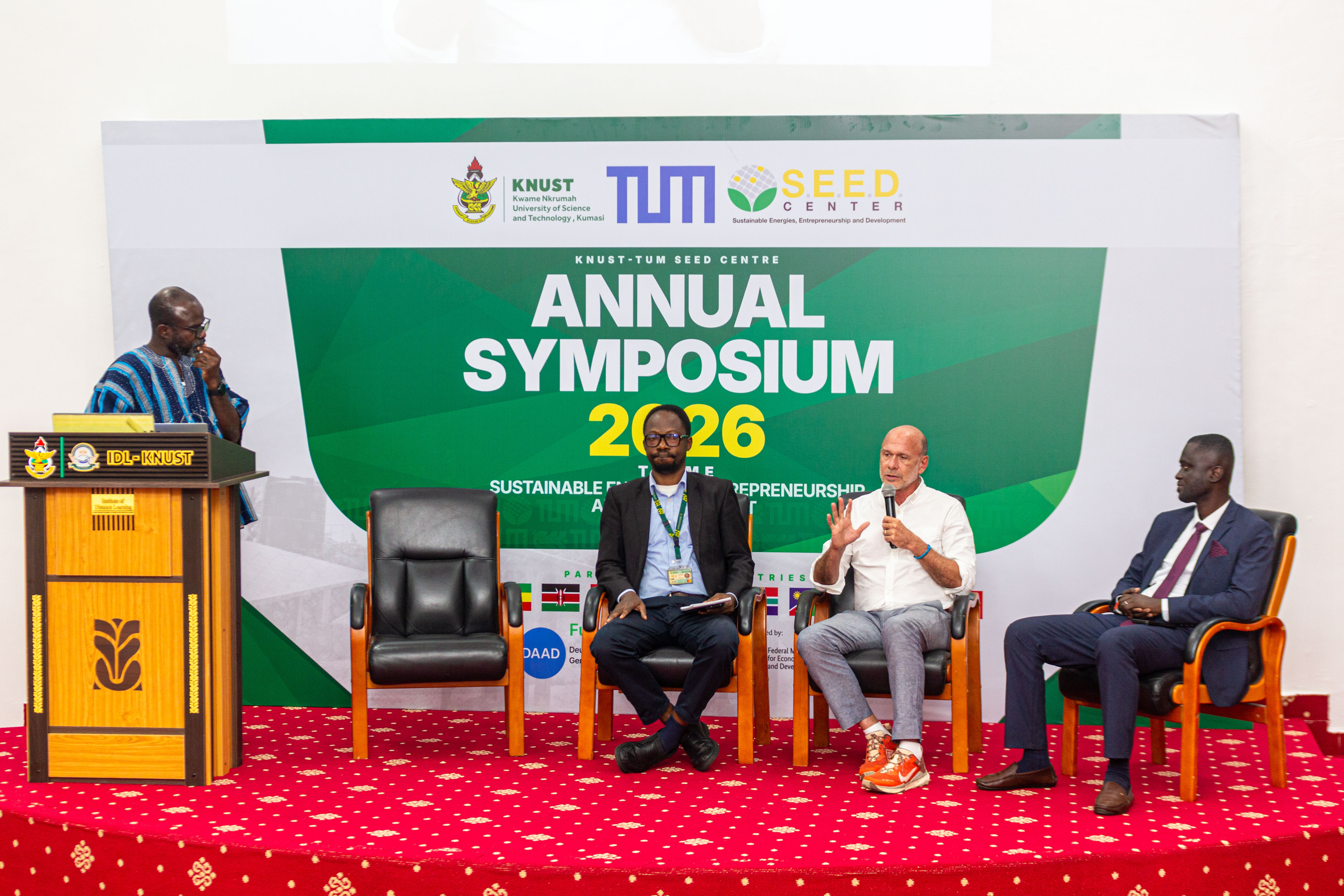
Experts at the KNUST-TUM SEED Centre Annual Symposium have called for stronger financing mechanisms, effective policy implementation and closer collaboration between academia and industry to accelerate Ghana's energy transition and support sustainable development across Africa.
The call came during a panel discussion on "Energy Transition in Ghana and Beyond," featuring Professor David Ato Quansah, Director of the KNUST Brew-Hammond Energy Centre; Mr William Brent, Chief Marketing Officer of Husk Power Systems; and Mr Kwame Obeng, Chief Executive Officer of Cosummate Engineering. Professor Francis Kemausuor moderated the discussion.
The panel examined opportunities and challenges in the transition to cleaner and more sustainable energy systems. Panellists agreed that while Ghana has made notable progress in creating an enabling policy environment, significant work remains to ensure renewable energy solutions are deployed at scale.
Mr Brent commended Ghana's efforts to expand energy access and establish supportive policies but said access to affordable financing remains one of the biggest barriers to scaling renewable energy technologies.
"Ghana is already doing a good job," he said, adding that innovative financing structures and greater access to affordable local-currency funding would help businesses expand renewable energy solutions to underserved communities.
He said many households and businesses face challenges meeting the upfront costs of renewable energy technologies such as solar and battery systems. He called for innovative financing models that would enable companies to expand their reach and make clean energy solutions more accessible.
Mr Brent also stressed the importance of developing sustainable business models that address customer needs while remaining commercially viable.
Mr Kwame Obeng said financing and effective implementation of existing policies were critical to accelerating the energy transition. He also advocated closer collaboration between universities and industry to translate research into practical solutions.
Speaking on the role of academia, Professor Quansah said universities and research institutions across Africa possess considerable knowledge and technical capacity that can contribute to the continent's energy transition.
"There is a lot of excellence and competence across our universities and research ecosystem," he said. "The key is to strengthen engagement with policymakers, industry and communities so that research can better respond to real-world challenges."
Professor Quansah said the transition was already underway at different levels and therefore required a coordinated approach involving researchers, government agencies, private-sector actors and local communities.
He urged universities to play a more active role in supporting entrepreneurship by identifying innovative ideas with commercial potential and equipping students with the skills needed to transform them into viable enterprises.
The panellists also underscored the importance of living laboratories as platforms for testing technologies and generating practical solutions. They said such initiatives could help bridge the long-standing gap between research and industry while providing valuable insights for policymakers and businesses.
On the future of higher education, Professor Quansah called on universities to strengthen training in climate change, sustainability, digitisation, artificial intelligence and machine learning, describing these areas as essential for the next generation of energy professionals.
"You cannot do anything meaningful in the energy space today without digital skills," he said.
The discussion also drew attention to Africa's vast biomass resources. Professor Quansah encouraged policymakers and researchers to take a fresh look at biomass and bioenergy as viable options for advancing sustainable energy development across the continent.
While acknowledging the potential of emerging technologies, Mr Brent said many of the solutions needed to drive the energy transition already exist and that the focus should be on improving deployment, reducing costs and adapting existing technologies to local contexts.
The panel discussion formed part of the KNUST-TUM SEED Centre Annual Symposium, which brought together researchers, policymakers, industry leaders and development partners to explore pathways for advancing sustainable energy, research and innovation.
Story: Abigail Ofori Photos: Isaac Kwaku Duah


